

With less than a month to go before the 2026 World Cup kicks off, Chinese fans are growing anxious as no broadcast deal has been finalized yet. The core issue has been pricing—FIFA initially asked for a fee deemed too high, but now the organization appears to be softening its stance, sending representatives to negotiate directly in China. This development has generated more buzz than a pre-season friendly.

Longtime fans recall that Chinese sponsors have been prominent at previous World Cups. If a broadcast deal falls through this time, it would hurt both sides, but FIFA likely feels the most pressure. Recent reports indicate that the broadcast rights fee has been slashed by nearly half, with FIFA reportedly willing to make a major concession. That the traditionally tough negotiator at FIFA is now showing flexibility underscores the weight of the Chinese market.
Many netizens have also noted a telling detail: FIFA’s official website supports over a dozen languages, including English, Japanese, and Korean, but notably lacks Chinese. Given the massive base of Chinese football fans, this omission has been a sore point. Some fans have suggested that adding Chinese language support should be a non-negotiable condition if a deal is reached, to avoid the hassle of translating official information.
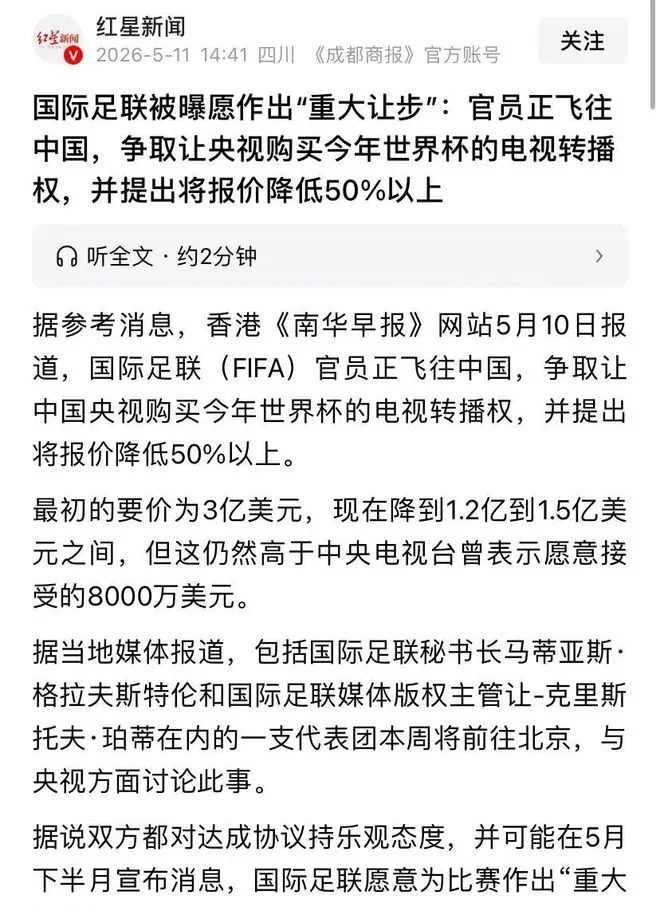
FIFA’s sincerity is evident as its copyright department staff have traveled to China to meet with state broadcaster CCTV, aiming to finalize the deal without further delays. The initial asking price was $300 million, widely considered excessive. Now, the revised offer is reportedly between $120 million and $150 million—a significant reduction of more than half.
However, even at this reduced price, it still exceeds CCTV’s expected budget of around $80 million. The gap remains substantial: even at the lower end of $120 million, there is a $40 million difference, and at the upper end of $150 million, the gap widens to $70 million. Closing that chasm won’t be a simple matter, and further negotiations are expected. Some observers have joked that the bargaining is more intense than online shopping discounts, but still hasn’t reached a final agreement.
Despite the disparity, the overall outlook is optimistic. Media sources suggest that talks are progressing positively, with both sides showing a cooperative attitude. An official announcement is expected in the second half of May. A key focus of negotiations is the possibility of packaging the broadcast rights for both the 2026 and 2030 World Cups. In essence, FIFA is offering a reduced price in exchange for securing a longer commitment, aiming to resolve the matter sooner rather than later.

Many analysts believe FIFA’s willingness to make such a large concession stems from a clear recognition: without access to the Chinese market, their sponsorship and advertising revenue would suffer. Even at a lower price, the sheer size of the Chinese audience—a nation of over 1.4 billion people with a huge football fan base—makes the deal too valuable to pass up. This logic seems to have hit the mark, as no one would walk away from such a lucrative market.
Fans have already made plans: some have adjusted work schedules, others have arranged viewing parties with barbecues and friends. Without a broadcast deal, all these preparations would be for nothing, adding to the urgency. The hope now is that both sides will compromise and finalize the agreement soon, so fans can enjoy the tournament without further anxiety.
All information so far comes from media reports rather than official confirmation. The final price and whether the package deal will be agreed upon remain to be seen. Nonetheless, FIFA’s proactive price reduction is a positive signal, indicating genuine interest in closing the deal.
Many fans are refreshing sports news daily, eagerly awaiting an official announcement. It’s understandable—the World Cup comes only once every four years, and everyone wants to cheer for their favorite team from the comfort of their living room. Some had worried the talks might collapse, but that possibility now seems remote. The final outcome is still pending.
Some fans have joked that FIFA’s realization came too late—had they set a reasonable price from the start, they could have avoided this drawn-out process. But in the end, as long as a deal is reached, a delay of a few days in the official announcement is acceptable. The key is to secure the rights and let everyone settle in for the matches.
Reference: CCTV report on 2026 World Cup broadcast rights negotiations in China.
